
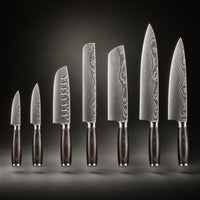

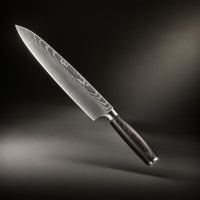


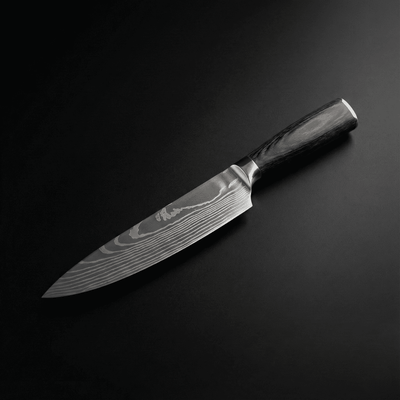


Scroll any kitchen knife set Black Friday page and you will see the same thing: a cliff of discounts, a wall of look-alike blades, and precious little explanation of what you are actually buying. The deal only matters if the knives would be worth owning at full price. Here is what to look for this year, and what quietly makes most "72% off" sets a bad trade — even at the sale price.
What actually makes a knife set worth it in a Black Friday sale
A worthwhile knife set does three things. It covers the handful of cuts that genuinely need a different blade — a chef's knife for most work, a smaller knife for peeling and detail, and a vegetable or utility knife for everything in between. It holds an edge long enough that you aren't sharpening more than you are cooking. And it feels good in your hand, because a knife you don't want to pick up is a knife you don't use. If a set misses any of those three, no amount of markdown closes the gap.
The right starting point is almost always a two- or three-piece set — a gyuto, a santoku or nakiri, and a petty. That is roughly 95% of home cooking covered with blades that have a real purpose. Anything larger tends to pad the box with knives you already own or will never reach for.
The traps every "kitchen knife set Black Friday" deal hides
Three issues come up every November, and they are easy to miss when you are looking at a price tag instead of a knife.
The first is MSRP inflation. A set marketed as "was $499, now $149" was often $149 to begin with. Checking the brand's own history, review archives, or the Wayback Machine takes thirty seconds and tells you whether the sale is real or theatrical.
The second is steel without a story. Serious knives name their steel — VG-10, AUS-10, 10Cr15MoV — because the alloy is the knife. "High-carbon stainless" with no further detail is marketing, not metallurgy. If a brand will not tell you what the blade is made of on the product page, assume it is commodity steel heat-treated to a soft hardness, which blunts quickly and takes longer to resharpen.
The third is the block. A seventeen-piece block with a built-in sharpener looks like value. In practice, it adds a steak-knife set and shears you already own, a honing rod that was never meant to sharpen anything, and three or four blades that duplicate work the chef's knife does better. Pay for the knives you will use, not the slot count.
A great knife set is three blades you reach for every day. Everything else is upholstery.
What a serious set looks like on the spec sheet
Spend thirty seconds on the spec sheet before you spend anything on the knife. The blade should name its steel and ideally its core — Damascus construction, for example, with a hard VG-10 core cladded in softer steel keeps a 60+ HRC edge where you want sharpness, and toughness on the outside. The handle should be stabilised wood, G10 or Micarta rather than hollow plastic. The tang should run full-length through the handle for balance. Grind geometry — a thin, true edge rather than a thick wedge — is what you can feel the moment the knife meets a tomato.
Finish and feel aren't vanity either. A hand-hammered or tsuchime surface releases wet produce more cleanly, so slices do not glue themselves to the blade. A rounded spine means your pinch grip stops going numb halfway through dicing an onion. These details separate a knife you keep for twenty years from a knife you replace in two.
Where Okura's Damascus knife sets fit
Our position here is simple. The chef's knife collection is built around the same philosophy regardless of what week of the year you are shopping — hand-forged Damascus blades, VG-10 cores, hardness around 60–61 HRC, triple-riveted stabilised wood handles, and full tangs. The two- and three-piece Damascus sets cover the real work of a kitchen without stuffing a box with duplicate blades. Each knife is backed by Okura's 25-year warranty, so the Black Friday maths does not rely on having to buy the same set again in three years.
If you want the broadest coverage, the three-piece Damascus set gives you a chef's knife, a vegetable knife and a petty — the trio most Japanese home cooks and professional kitchens actually use. If you already own a good santoku or gyuto, a two-piece set is often the smarter buy.
How to decide this Black Friday
Ignore the countdown clock long enough to answer three questions. What do you cook most often, and which blades does that work genuinely require? What steel and construction are you actually buying — not what the hero image suggests? And how long is the manufacturer willing to stand behind the knife after the sale ends?
Get those answers right and the discount becomes what it should be: a reason to buy a knife set you already wanted. Get them wrong and even a free knife is a bad deal, because a dull, uncomfortable blade just sends you back to the same box next November.
Ready to compare? Start with the two- and three-piece options in our chef's knife collection — the specs are on every product page so you can see exactly what you are getting before anything hits the cart.